 Add to Chrome
 Add to Firefox
 Add to Edge
Decomposing Subject-Driven Image Generation via Intermediate Structural Prediction
May 20, 2026
Subject-driven text-to-image generation still struggles to preserve high-frequency identity details such as logos, patterns, and text. Existing methods typically operate directly in RGB space, which often leads to detail degradation under substantial edits. We propose a two-stage framework that decouples structure from appearance by first predicting a Canny map and then rendering the final image conditioned on both the source appearance and the predicted structure. To improve text handling, we further introduce a fully automatic pipeline that constructs a 100k-pair text-aware dataset with cross-view textual consistency. Experiments, including GPT-4.1-based evaluation and a knowledge distillation study, show clear gains over selected baselines and suggest that intermediate structural prediction is an effective route for high-fidelity subject-driven generation. Our dataset and code will be made publicly available.

CosFly: Plan in the Matrix, Fly in the World
May 18, 2026We present CosFly, a box-structured planning and multimodal simulation pipeline for aerial tracking, together with CosFly-Track, a large-scale UAV dataset for dynamic target tracking across diverse environments including urban centers, highways, rural landscapes, forests, and coastal towns. In our current implementation on CARLA, CosFly provides a modular 7-step construction pipeline that converts complex 3D worlds into structured obstacle representations for planning, then projects the resulting trajectories back into multi-modal sensor data -- including RGB images, high-precision depth maps, and semantic segmentation masks -- paired with natural language navigation instructions. A key feature is the support for configurable fixed-FOV zoom levels (one FOV setting drawn per trajectory and held constant throughout), enabling simulation of various focal lengths through camera-intrinsic adjustments. The pipeline covers the complete workflow from 3D map export through grid simplification, pedestrian and drone trajectory planning, multi-modal rendering with 6-DOF pose annotations, quality inspection, and teacher-student caption generation. We analyze two trajectory-planning paradigms for aerial target tracking: a conventional two-stage pipeline with front-end candidate generation and backend refinement, and a direct gradient-based formulation that optimizes multiple tracking constraints in a single objective. The public CosFly-Track release contains 250 validated trajectories and approximately 100,000 rendered images with complete 6-DOF drone pose annotations (position x, y, z and orientation yaw, pitch, roll). Together, the pipeline and dataset establish a scalable foundation for aerial-ground collaborative research, supporting dynamic target tracking, UAV navigation, and multi-modal perception across diverse environments.
Overcoming Catastrophic Forgetting in Visual Continual Learning with Reinforcement Fine-Tuning
May 10, 2026Recent studies suggest that Reinforcement Fine-Tuning (RFT) is inherently more resilient to catastrophic forgetting than Supervised Fine-Tuning (SFT). However, whether RFT (e.g., GRPO) can effectively overcome forgetting in challenging visual continual learning settings, such as class-incremental learning (CIL) and domain-incremental learning (DIL), remains an open problem. Through a pilot study, we confirm that while RFT consistently outperforms SFT, it still suffers from non-negligible forgetting. We empirically trace this bottleneck to Trajectory-level Drift Agnosticism: among candidate rollouts achieving identical task rewards, the KL divergence from the preceding-task policy varies substantially, which strongly correlates with catastrophic forgetting across sequential tasks. Motivated by this insight, we propose Retention-aware Policy Optimization (RaPO), a simple yet effective RFT method that explicitly mitigates forgetting through trajectory-level reward shaping. Specifically, RaPO comprises two core components: (1) Retention Reward that converts trajectory-level distribution drift into a continuous reward signal, preferentially reinforcing knowledge-preserving rollouts within each group; (2) Cross-Task Advantage Normalization (CTAN), which maintains a persistent exponential moving average of reward statistics across task boundaries to stabilize the optimization progress during continual learning. Leveraging the free-form textual generalization of MLLMs, we comprehensively evaluate RaPO across five visual continual learning settings. Extensive experiments demonstrate that RaPO achieves leading performance, substantially reducing catastrophic forgetting while preserving strong plasticity. To the best of our knowledge, this work represents the first systematic exploration of RFT in visual continual learning, offering insights that we hope will inspire future research.
Seedance 2.0: Advancing Video Generation for World Complexity
Apr 15, 2026Seedance 2.0 is a new native multi-modal audio-video generation model, officially released in China in early February 2026. Compared with its predecessors, Seedance 1.0 and 1.5 Pro, Seedance 2.0 adopts a unified, highly efficient, and large-scale architecture for multi-modal audio-video joint generation. This allows it to support four input modalities: text, image, audio, and video, by integrating one of the most comprehensive suites of multi-modal content reference and editing capabilities available in the industry to date. It delivers substantial, well-rounded improvements across all key sub-dimensions of video and audio generation. In both expert evaluations and public user tests, the model has demonstrated performance on par with the leading levels in the field. Seedance 2.0 supports direct generation of audio-video content with durations ranging from 4 to 15 seconds, with native output resolutions of 480p and 720p. For multi-modal inputs as reference, its current open platform supports up to 3 video clips, 9 images, and 3 audio clips. In addition, we provide Seedance 2.0 Fast version, an accelerated variant of Seedance 2.0 designed to boost generation speed for low-latency scenarios. Seedance 2.0 has delivered significant improvements to its foundational generation capabilities and multi-modal generation performance, bringing an enhanced creative experience for end users.
Vision-and-Language Navigation for UAVs: Progress, Challenges, and a Research Roadmap
Apr 15, 2026Vision-and-Language Navigation for Unmanned Aerial Vehicles (UAV-VLN) represents a pivotal challenge in embodied artificial intelligence, focused on enabling UAVs to interpret high-level human commands and execute long-horizon tasks in complex 3D environments. This paper provides a comprehensive and structured survey of the field, from its formal task definition to the current state of the art. We establish a methodological taxonomy that charts the technological evolution from early modular and deep learning approaches to contemporary agentic systems driven by large foundation models, including Vision-Language Models (VLMs), Vision-Language-Action (VLA) models, and the emerging integration of generative world models with VLA architectures for physically-grounded reasoning. The survey systematically reviews the ecosystem of essential resources simulators, datasets, and evaluation metrics that facilitates standardized research. Furthermore, we conduct a critical analysis of the primary challenges impeding real-world deployment: the simulation-to-reality gap, robust perception in dynamic outdoor settings, reasoning with linguistic ambiguity, and the efficient deployment of large models on resource-constrained hardware. By synthesizing current benchmarks and limitations, this survey concludes by proposing a forward-looking research roadmap to guide future inquiry into key frontiers such as multi-agent swarm coordination and air-ground collaborative robotics.
Video Generation Models as World Models: Efficient Paradigms, Architectures and Algorithms
Mar 30, 2026The rapid evolution of video generation has enabled models to simulate complex physical dynamics and long-horizon causalities, positioning them as potential world simulators. However, a critical gap still remains between the theoretical capacity for world simulation and the heavy computational costs of spatiotemporal modeling. To address this, we comprehensively and systematically review video generation frameworks and techniques that consider efficiency as a crucial requirement for practical world modeling. We introduce a novel taxonomy in three dimensions: efficient modeling paradigms, efficient network architectures, and efficient inference algorithms. We further show that bridging this efficiency gap directly empowers interactive applications such as autonomous driving, embodied AI, and game simulation. Finally, we identify emerging research frontiers in efficient video-based world modeling, arguing that efficiency is a fundamental prerequisite for evolving video generators into general-purpose, real-time, and robust world simulators.
RewardDance: Reward Scaling in Visual Generation
Sep 10, 2025Reward Models (RMs) are critical for improving generation models via Reinforcement Learning (RL), yet the RM scaling paradigm in visual generation remains largely unexplored. It primarily due to fundamental limitations in existing approaches: CLIP-based RMs suffer from architectural and input modality constraints, while prevalent Bradley-Terry losses are fundamentally misaligned with the next-token prediction mechanism of Vision-Language Models (VLMs), hindering effective scaling. More critically, the RLHF optimization process is plagued by Reward Hacking issue, where models exploit flaws in the reward signal without improving true quality. To address these challenges, we introduce RewardDance, a scalable reward modeling framework that overcomes these barriers through a novel generative reward paradigm. By reformulating the reward score as the model's probability of predicting a "yes" token, indicating that the generated image outperforms a reference image according to specific criteria, RewardDance intrinsically aligns reward objectives with VLM architectures. This alignment unlocks scaling across two dimensions: (1) Model Scaling: Systematic scaling of RMs up to 26 billion parameters; (2) Context Scaling: Integration of task-specific instructions, reference examples, and chain-of-thought (CoT) reasoning. Extensive experiments demonstrate that RewardDance significantly surpasses state-of-the-art methods in text-to-image, text-to-video, and image-to-video generation. Crucially, we resolve the persistent challenge of "reward hacking": Our large-scale RMs exhibit and maintain high reward variance during RL fine-tuning, proving their resistance to hacking and ability to produce diverse, high-quality outputs. It greatly relieves the mode collapse problem that plagues smaller models.
UniMC: Taming Diffusion Transformer for Unified Keypoint-Guided Multi-Class Image Generation
Jul 03, 2025Although significant advancements have been achieved in the progress of keypoint-guided Text-to-Image diffusion models, existing mainstream keypoint-guided models encounter challenges in controlling the generation of more general non-rigid objects beyond humans (e.g., animals). Moreover, it is difficult to generate multiple overlapping humans and animals based on keypoint controls solely. These challenges arise from two main aspects: the inherent limitations of existing controllable methods and the lack of suitable datasets. First, we design a DiT-based framework, named UniMC, to explore unifying controllable multi-class image generation. UniMC integrates instance- and keypoint-level conditions into compact tokens, incorporating attributes such as class, bounding box, and keypoint coordinates. This approach overcomes the limitations of previous methods that struggled to distinguish instances and classes due to their reliance on skeleton images as conditions. Second, we propose HAIG-2.9M, a large-scale, high-quality, and diverse dataset designed for keypoint-guided human and animal image generation. HAIG-2.9M includes 786K images with 2.9M instances. This dataset features extensive annotations such as keypoints, bounding boxes, and fine-grained captions for both humans and animals, along with rigorous manual inspection to ensure annotation accuracy. Extensive experiments demonstrate the high quality of HAIG-2.9M and the effectiveness of UniMC, particularly in heavy occlusions and multi-class scenarios.
MagicDistillation: Weak-to-Strong Video Distillation for Large-Scale Portrait Few-Step Synthesis
Mar 17, 2025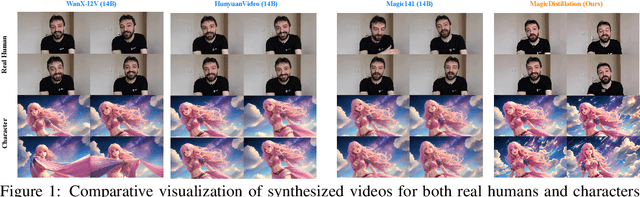
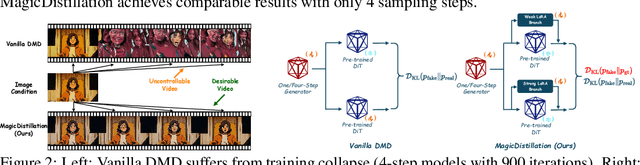
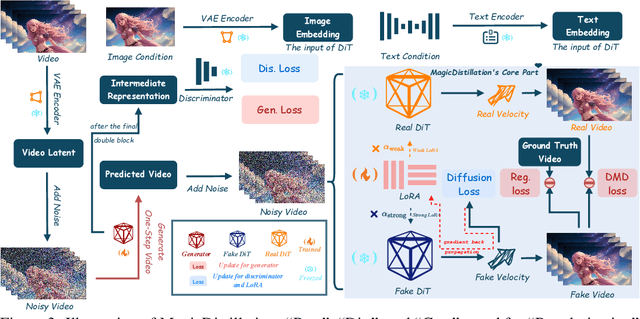
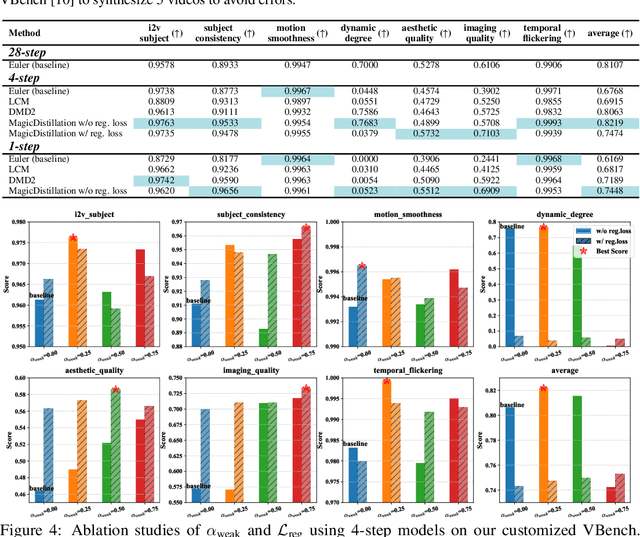
Fine-tuning open-source large-scale VDMs for the portrait video synthesis task can result in significant improvements across multiple dimensions, such as visual quality and natural facial motion dynamics. Despite their advancements, how to achieve step distillation and reduce the substantial computational overhead of large-scale VDMs remains unexplored. To fill this gap, this paper proposes Weak-to-Strong Video Distillation (W2SVD) to mitigate both the issue of insufficient training memory and the problem of training collapse observed in vanilla DMD during the training process. Specifically, we first leverage LoRA to fine-tune the fake diffusion transformer (DiT) to address the out-of-memory issue. Then, we employ the W2S distribution matching to adjust the real DiT's parameter, subtly shifting it toward the fake DiT's parameter. This adjustment is achieved by utilizing the weak weight of the low-rank branch, effectively alleviate the conundrum where the video synthesized by the few-step generator deviates from the real data distribution, leading to inaccuracies in the KL divergence approximation. Additionally, we minimize the distance between the fake data distribution and the ground truth distribution to further enhance the visual quality of the synthesized videos. As experimentally demonstrated on HunyuanVideo, W2SVD surpasses the standard Euler, LCM, DMD and even the 28-step standard sampling in FID/FVD and VBench in 1/4-step video synthesis. The project page is in https://w2svd.github.io/W2SVD/.
Modality-Composable Diffusion Policy via Inference-Time Distribution-level Composition
Mar 16, 2025Diffusion Policy (DP) has attracted significant attention as an effective method for policy representation due to its capacity to model multi-distribution dynamics. However, current DPs are often based on a single visual modality (e.g., RGB or point cloud), limiting their accuracy and generalization potential. Although training a generalized DP capable of handling heterogeneous multimodal data would enhance performance, it entails substantial computational and data-related costs. To address these challenges, we propose a novel policy composition method: by leveraging multiple pre-trained DPs based on individual visual modalities, we can combine their distributional scores to form a more expressive Modality-Composable Diffusion Policy (MCDP), without the need for additional training. Through extensive empirical experiments on the RoboTwin dataset, we demonstrate the potential of MCDP to improve both adaptability and performance. This exploration aims to provide valuable insights into the flexible composition of existing DPs, facilitating the development of generalizable cross-modality, cross-domain, and even cross-embodiment policies. Our code is open-sourced at https://github.com/AndyCao1125/MCDP.